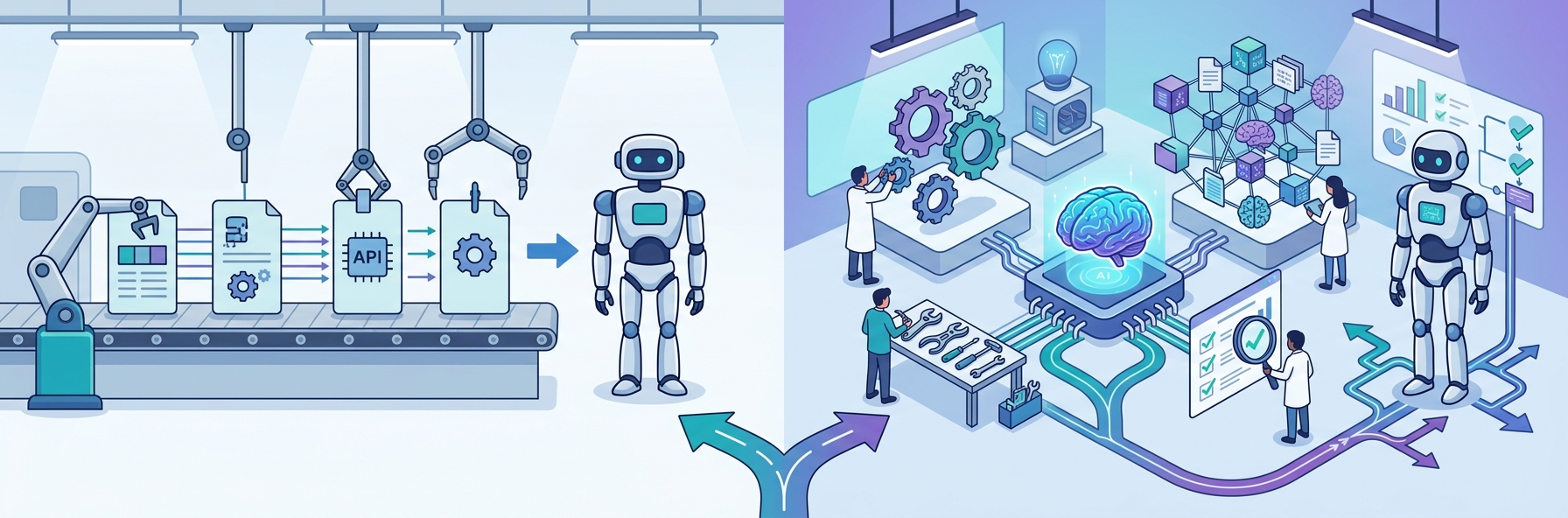
The AI agent market offers two paths: off-the-shelf agent platforms and custom AI agent development.
Off-the-shelf platforms are faster to deploy and cheaper upfront. They handle standard use cases well. For organizations with standard workflows and standard requirements, they’re the right starting point.
Custom AI agent development is appropriate when the requirements don’t fit the standard mold — when the workflow is complex enough to require specific orchestration logic, when the integration landscape is unusual enough to require custom tool development, when the data is proprietary enough to require fine-tuning or specialized retrieval, or when the accuracy requirements are high enough that a generic agent can’t meet them.
Understanding which path fits your situation — and what custom AI agent development actually involves when it’s the right choice — is the starting point for making a good decision.
When Custom AI Agent Development Is Actually Warranted
The honest answer: less often than developers prefer and more often than platform vendors admit.
Off-the-shelf agent platforms have improved significantly. Many standard business automation workflows — customer inquiry handling, document routing, data extraction, report assembly — can be addressed with configurable platforms without custom development. If a platform covers your use case adequately, custom development adds cost and complexity without adding proportional value.
Custom AI agent development is warranted when:
The workflow has specific orchestration requirements that generic frameworks don’t support. Complex branching logic, multi-turn decision sequences, specialized memory patterns, unusual tool coordination requirements — cases where the workflow structure doesn’t fit the assumptions built into off-the-shelf platforms.
The integration landscape requires custom tool development. Proprietary internal systems, legacy APIs without standard connectors, real-time data sources that require custom handling — integrations that off-the-shelf platforms can’t reach or can only reach with workarounds that compromise reliability.
The domain requires specialized knowledge that generic models don’t have. Medical coding, legal document analysis, financial risk assessment, highly technical product support — domains where a generic language model’s knowledge is insufficient and where fine-tuning or retrieval-augmented generation with proprietary knowledge bases is required to reach acceptable accuracy.
The accuracy requirements exceed what platform agents achieve. Some use cases have accuracy requirements that standard agents can’t meet on the specific task distribution. Custom development — with targeted fine-tuning, specialized evaluation frameworks, and iterative refinement — can reach performance levels that generic solutions can’t.
The security or compliance requirements rule out cloud platforms. On-premise deployment, air-gapped environments, data residency requirements, specific security controls — requirements that cloud-hosted agent platforms can’t satisfy.
What Custom AI Agent Development Actually Builds
Custom AI agent development is not just prompt engineering with more steps. It’s a full engineering discipline with distinct layers, each requiring specialized expertise.
The Reasoning Core
The model or models at the center of the agent. Custom development allows the reasoning core to be tailored to the specific task through fine-tuning on domain-specific data, optimization of prompting strategies for the specific task distribution, selection of the model architecture most appropriate for the requirements, and integration of multiple models for different components of complex workflows.
Generic platforms use generic reasoning cores with generic prompting. Custom development optimizes the reasoning layer for the specific problem.
The Orchestration Layer
The logic that determines how the agent plans, sequences actions, handles branching, recovers from failures, and maintains coherence across multi-step tasks.
Custom orchestration is what makes complex workflows possible. Off-the-shelf orchestration handles linear sequences and simple branching. Custom orchestration handles the complex, conditional, multi-path workflows that real business processes require.
This layer is also where the performance characteristics are determined. An orchestration approach optimized for accuracy may be slower than one optimized for speed. An approach optimized for cost efficiency may sacrifice some accuracy. Custom development allows these tradeoffs to be made deliberately based on the specific requirements, rather than accepting whatever tradeoffs a platform made for a generic use case.
The Tool Layer
The interfaces between the agent and the systems it needs to interact with. Every tool is a capability and a risk surface.
Custom tool development involves more than connecting APIs. It requires:
- Input validation to prevent the agent from calling tools with parameters that could cause unintended effects
- Authorization logic to ensure the agent is permitted to take each action in each context
- Error handling that defines exactly what the agent does when each tool fails, times out, or returns unexpected results
- Retry logic with appropriate backoff strategies for transient failures
- Idempotency design to prevent duplicate effects when retries occur
- Comprehensive logging to create the audit trail that enables debugging and oversight
Generic platform tool integrations handle the happy path. Custom tool development handles the full operational reality.
The Memory Architecture
What the agent knows and can access at each point in a task. Custom memory architectures allow the memory layer to be designed for the specific task requirements:
- Working memory sized and managed for the specific task complexity and context window requirements
- Long-term storage designed for the types of information that need to persist across sessions
- Retrieval mechanisms optimized for the specific knowledge base structure and query patterns
- Episodic memory for agents that need to learn from past interactions
Generic platforms provide standard memory patterns. Custom development allows the memory layer to be optimized for the specific workflow.
The Evaluation Framework
How you know the agent is working correctly — both during development and after deployment.
Custom evaluation frameworks are designed to reflect the actual task distribution the agent will encounter in production, including edge cases, low-frequency inputs, and failure modes specific to the domain. They define performance thresholds based on business requirements rather than benchmark scores, and include regression testing that runs whenever anything in the system changes.
Generic platforms provide standard evaluation approaches. Custom evaluation is what makes it possible to know whether the agent meets the actual requirements rather than the benchmark.
The Custom AI Agent Development Process
| Phase | Duration | Primary Output |
|---|---|---|
| Requirements and feasibility | 2-4 weeks | Task specification, feasibility assessment, go/no-go recommendation |
| Architecture design | 2-3 weeks | System architecture, tool inventory, memory model, orchestration approach |
| Evaluation framework design | 1-2 weeks | Test suite design, performance thresholds, edge case library |
| Tool layer development | 4-8 weeks | Custom tool integrations with full production hardening |
| Core agent development | 6-10 weeks | Reasoning core, orchestration logic, memory implementation |
| Evaluation and iteration | 3-5 weeks | Performance validation, edge case handling, threshold verification |
| Production deployment | 2-3 weeks | Infrastructure, monitoring, oversight model implementation |
| Knowledge transfer | Throughout + 2 weeks | Internal team capability, documentation, runbooks |
| Total | 20-35 weeks | Production-ready custom AI agent |
The Build vs. Platform Decision
The decision framework for custom AI agent development vs. off-the-shelf platforms:
| Factor | Favors Platform | Favors Custom |
|---|---|---|
| Workflow complexity | Standard, linear | Complex, conditional, multi-path |
| Integration requirements | Standard APIs with connectors | Proprietary or legacy systems |
| Domain specificity | General knowledge sufficient | Specialized domain knowledge required |
| Accuracy requirements | Platform benchmarks sufficient | Higher accuracy required on specific distribution |
| Security requirements | Cloud deployment acceptable | On-premise or specific controls required |
| Timeline | Fast deployment needed | Performance requirements justify longer timeline |
| Budget | Lower upfront cost required | Total cost over time justifies custom investment |
The decision is almost never obvious from a single factor. The combination of factors — particularly workflow complexity, integration requirements, and accuracy requirements — is what determines whether custom development is justified.
What to Expect from a Custom AI Agent Development Partner
A development partner with genuine custom AI agent development experience will:
- Conduct a serious feasibility assessment before committing to development, including an honest recommendation if a platform solution would serve the requirements adequately
- Design the evaluation framework before building the agent
- Build tool integrations with full production hardening, not just happy-path connectivity
- Design the oversight model as an architectural component, not an afterthought
- Build monitoring infrastructure alongside the agent, not after deployment
- Transfer knowledge throughout the engagement, not just at handoff
The combination of these practices is what separates custom AI agent development that produces lasting value from custom development that produces expensive, hard-to-maintain systems that work at launch and degrade over time.
Custom AI agent development is the right investment when the requirements genuinely exceed what platforms can deliver. The decision to go custom should be deliberate — based on specific requirements that platforms can’t meet — not a default assumption that custom is always better.
When custom is the right answer, the development process that produces lasting value starts with requirements and feasibility, designs the evaluation framework before the agent, and builds the monitoring and oversight infrastructure that keeps the agent reliable after deployment.
Published: August 26, 2026