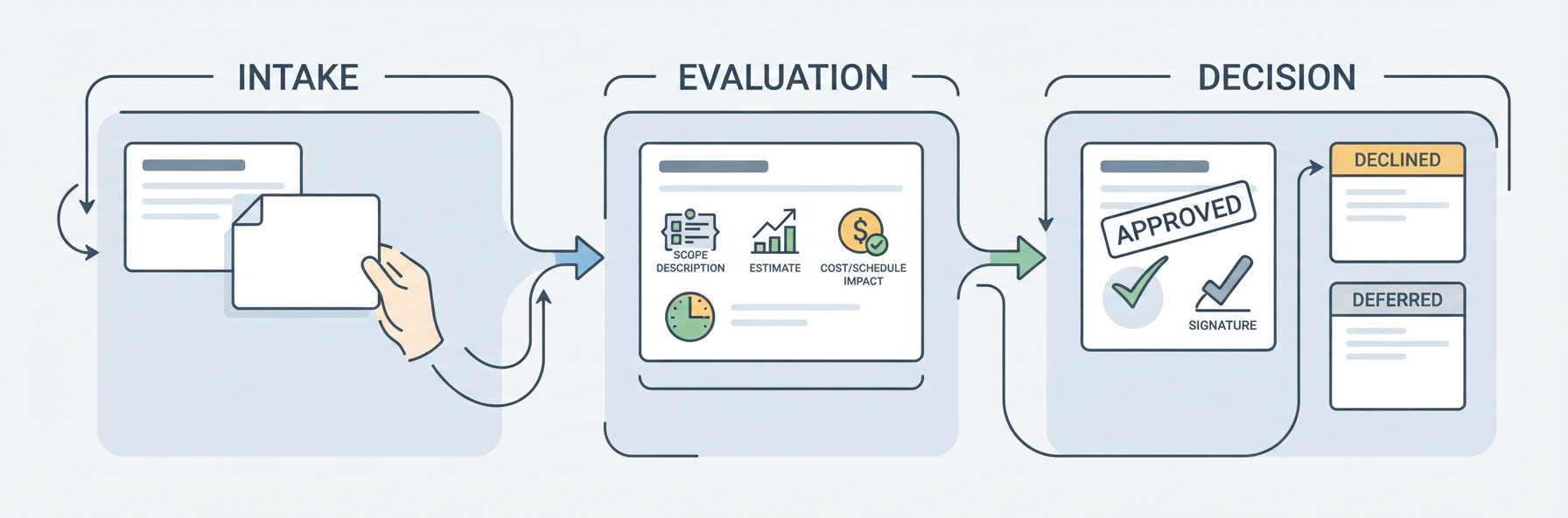
A reliable software change request process places every requested change on a single shared board, where each card carries its own scope description, effort estimate and approval decision as it moves from intake to release. When the request, its cost and the final decision live in one place, nobody has to search through email threads to understand why the release date moved. The board becomes the record of what the team agreed to build and why.
What a software change request process actually solves
Picture a client asking for “just one more export button” two weeks before launch, with the request never written down. The button grows into CSV and PDF formats, role-based permissions and a scheduled email report, which moves the launch back by almost a full sprint. Nobody does anything wrong, but there is no moment when someone looks at the full cost and makes a decision.
That’s the real purpose of change request management in software development: giving each request a short pause so the right people can understand it before work begins. A clear process is just as useful when part of the team works remotely. When you partner with an offshore software development company that records every change together with its estimate, both sides share the same picture of scope and cost, and new ideas can be added to the plan without surprises.
What goes into a software change request template
A change request card can be short, but it should always contain the same fields. The software change request template below works as a starting point and can be adapted for each client or project.
| Field | What to write | Who fills it in |
|---|---|---|
| Summary | One plain sentence describing the change | Requester |
| Reason | The business problem or user complaint behind it | Requester |
| Scope impact | Screens, integrations and data affected | Tech lead |
| Estimate | Effort range in hours or story points, plus known risks | Development team |
| Schedule and cost effect | What moves if the change is approved | Project manager |
| Decision | Approved, declined or deferred, with a name and date | Approver |
The field people most frequently skip is the reason. Without a clear reason, there’s no way to judge whether a change is worth its estimate, and the discussion turns into a debate about opinions.
Setting up one board for every change
Change requests work best on a dedicated board, separate from the product backlog. Each column in this software change request workflow represents a decision, so a card only moves forward after someone has actually made that decision. It works in any kanban tool, and especially well on an online whiteboard such as Weje, where cards can sit next to mockups, notes and the client’s original message.
Intake
New requests arrive here with the template completed by the requester, and any card missing a summary or a reason goes straight back. Some teams let an AI assistant draft the summary from a client’s email or call notes, but a person should still confirm the reason before the card moves on.
Impact and estimate
The tech lead documents everything the change affects, and the developers attach an estimate. We always request a range, such as 12 to 20 hours, because a single number conceals the real uncertainty.
Approval
The card waits here until the person responsible for that decision reviews it. When the work is delivered by an offshore software development company, its project manager adds the cost impact before the card reaches the client.
Scheduled and closed
Approved cards move into the sprint plan with a link to the actual task, while declined and deferred cards remain visible in a separate column, so the same idea doesn’t reappear later disguised as something new.
Keeping estimates and approvals honest
Most approval problems come from unclear authority, because when anyone can approve a change, nobody owns the consequences. It helps to agree on simple approval thresholds with the client at kickoff:
- Changes under one day of work can be approved by the product owner.
- Anything that moves the release date requires the project sponsor.
- Changes that affect the contract value go to whoever signed the contract.
- Urgent production fixes skip the queue but still receive a card afterwards.
An estimate attached to a decision is worth far more than an estimate in a chat message. When the approver sees the range, the risk and the trade-off on the same card, the conversation shifts from blame to priorities.
Change requests with an external development team
Outsourcing adds another layer, because every change request also becomes a commercial document. With offshore teams, the smoothest collaborations usually rely on a single board shared with the vendor, so both sides see identical estimates and every approval is recorded on the card.
Many offshore software development companies already have a standard change order form, so ask how it maps to your board before the project starts. When choosing a team offshore, find out how their software development company prices minor changes on fixed-price work. A reliable offshore software development company will often suggest a monthly change budget, a set number of hours that a good development partner can spend on small tweaks without separate approvals.
Project scope change management after launch
The board remains useful after release, because real users usually generate more requests than the original stakeholders did. A review with the client every two weeks shows how many requests came in, how long cards waited for approval and how actual effort compared with the estimates.
On one support project, that review showed that approvals took about nine days on average, longer than most of the changes took to build. After the product owner received authority over small requests, waiting time dropped to under three days. The board’s own history showed where the process was slow, so nobody had to guess.
Regular reviews matter because scope creep is far more common than most teams expect. When the Project Management Institute measured it in its 2018 Pulse of the Profession research, 52% of projects completed in the previous year had experienced scope creep or uncontrolled changes, up from 43% five years earlier. In practice, a lot of that creep starts as small, reasonable requests that nobody writes down.
Final thoughts: what one board should tell you
A software change request process works when anyone on the project can open the board and immediately see what was requested, what it costs and who approved it. To set one up, create columns for intake, estimation, approval, scheduled work and closed requests, add the template fields to every card, and agree on approval thresholds before the next request arrives. If part of your team is external, invite the vendor to the same board and ask your offshore software development company to record estimates and cost impact directly on the cards.
A change that isn’t on the board doesn’t get built, and every decision on the board has a name and a date next to it. That rule alone keeps scope, estimates and approvals in one place, which is the whole point of the process.
Published: November 20, 2026