Inbound communication is getting more complex to manage with human teams. The thing is, customers could contact a company via email, phone, live chat, contact forms, social channels, self-service portals, and more. Furthermore, they often expect fast answers, no matter which channel they use. For support teams, this creates a significant challenge. They have to respond quickly, control operating costs, and provide accurate, context-aware service when problems are critical.
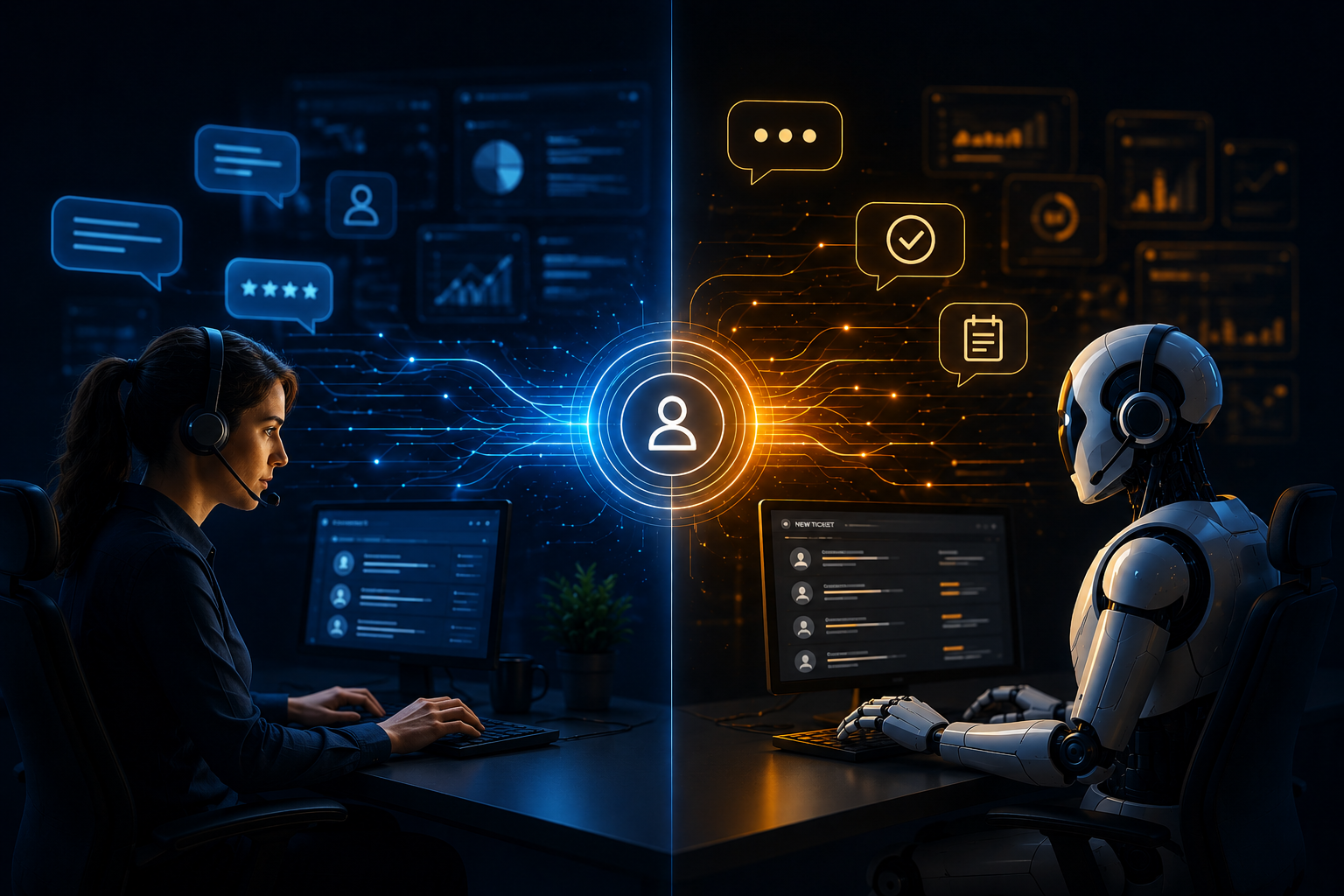
That’s where AI responders come in handy. They don’t replace human agents entirely. However, they can handle repetitive inbound work. To be more specific, they answer typical questions, arrange emails, move tickets, and go through call context. Moreover, they can help customers complete simple tasks with the help of self-service bots. Human agents, in turn, are vital for sensitive cases, high-value customers, complaints, negotiations, and situations where their judgment is required.
That said, the choice isn’t between AI and human agent performance. It’s more important to understand how to combine automation and human performance to build a hybrid support model and scale without compromising service quality.
The Operational Reality of High-Volume Customer Support
Handling inbound communication at scale is rather a coordination issue. Customers may begin with a chatbot, keep it up by email, and finally, speak with a support agent. Unless these interactions remain connected, agents often spend valuable time reconstructing the conversation instead of resolving the issue.
This becomes more noticeable as organizations introduce additional products, markets, and support channels. Each new system brings another source of customer information, making it more difficult to maintain a complete picture of every interaction.
That’s why organizations don’t focus on reducing headcount. Instead, they prioritize decreasing unnecessary work. They automate repetitive inquiries, collect customer info before escalation, and route requests to the most appropriate team. Hence, specialists can spend more time solving problems that require their precise attention.
What AI Responders Actually Do
For many companies, the value of AI responders is in the steps prior to the agent’і involvement. Before reaching the support queue, it‘s possible to automatically categorize and prioritize incoming emails, chats, and web requests, adding customer information.
If the request matches a known workflow, the system can often complete the interaction independently. It may provide shipping information, answer policy questions, verify account details, or guide users through common procedures using a business chatbot platform. More complex conversations are transferred to human agents together with conversation history, customer data, and suggested responses, reducing the amount of manual investigation required.
This approach shortens handling time while allowing support teams to maintain consistent service across multiple communication channels.
Some Conversations Still Need a Person
Automation works well when requests follow recognizable patterns. Human conversations rarely do.
A customer explaining a service failure, discussing a contract issue, or reporting an unusual technical problem often provides incomplete information. Understanding the real issue may require clarification, interpretation, and experience rather than simply selecting the closest answer from a knowledge base.
Human agents also notice details that influence the outcome of a conversation but are difficult to encode into business rules. In particular, they can recognize things like frustration, uncertainty, urgency, or opportunities to strengthen customer relationships. These are factors that significantly affect satisfaction even when the technical resolution is the same.
As a result, many organizations use automation to reduce queue volume while reserving experienced specialists for interactions where communication itself becomes part of the solution.
Choosing the Right Resource for Each Conversation
The strengths of AI responders depend largely on the type of interaction rather than the communication channel itself.
Routine, repeatable requests are usually handled more efficiently through automation. These include balance inquiries, order updates, password resets, appointment scheduling, and policy questions where the required information already exists within connected business systems. Many implement these capabilities thanks to AI chatbot development services, which allows responders to access business data and complete routine workflows without human effort.
Human agents deliver greater value when conversations become unpredictable. They investigate unusual cases, resolve disputes, explain exceptions, and make decisions that depend on business context rather than predefined workflows.
Many organizations therefore evaluate automation by resolution quality rather than automation rate alone. Escalating the right conversations early often produces better outcomes than attempting to automate every customer interaction.
Giving Customers Another Way to Resolve Routine Requests
Many customers prefer solving straightforward problems themselves rather than waiting for an available representative. Self-service bots support this preference by providing immediate access to information and common account functions through a conversational interface.
Their value extends beyond convenience. Each completed self-service interaction decreases queue length, which allows human agents to dedicate more time to things like technical issues, exceptions, and meaningful conversations. Over time, this shift improves response times and overall service consistency while not requiring proportional increases in staffing.
Building a Hybrid Support Model
Most organizations no longer view automation as an alternative to human support. In contrast, they assign work based on a specific request type.
AI responders focus on routine interactions, from account inquiries and order updates to appointment scheduling and ticket routing.
In turn, human agents concentrate on technical investigations, exceptions, escalations, and conversations where negotiation is needed.
A typical workflow reflects this division of responsibilities. An inbound request is first analyzed and either resolved automatically or enriched with customer information before being transferred to the appropriate specialist. Rather than starting from scratch, the agent receives the conversation history, relevant account data, and the actions already performed. This reduces handling time while allowing support teams to maintain a consistent customer experience even as inbound volumes continue to grow.
Scaling Support Without Losing the Human Element
As customer expectations grow, support teams are under increasing pressure. The need to deliver fast, consistent service through every communication channel. AI responders embrace most routine workloads, so that human agents can focus on conversations requiring their experience, critical thinking, and sound judgment.
The strongest support operations aren’t built around automation alone. Combining AI chatbot development services and AI assistant development with experienced support teams lets organizations boost efficiency and preserve the quality of the most valuable customer interactions.
Published: July 8, 2026