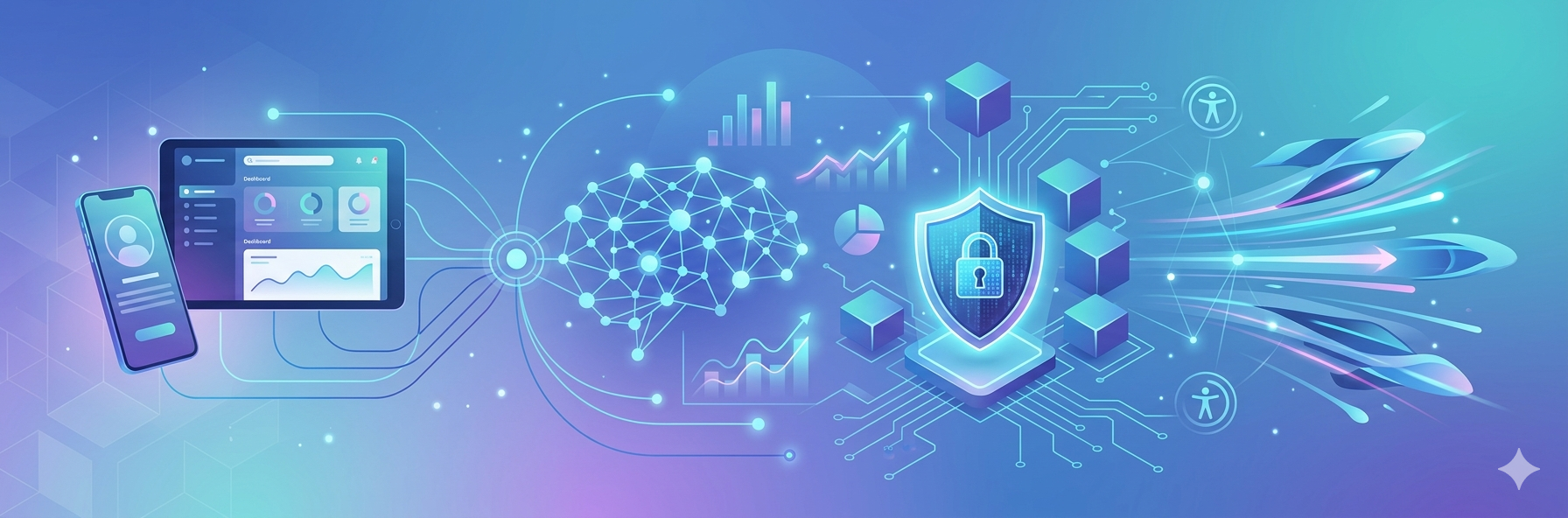
In 2026, web portals are not just “places” to grab info anymore. They’ve basically grown into intelligent digital ecosystems that quietly shape the customer mood, help internal teams work more smoothly, and yeah, they can even push business growth in a direct way.
Users today expect more than plain functionality. They want it fast, personalized, protected, and easy to navigate without feeling stuck. Also, they expect everything to work across every device as planned. If a business can’t match that, then engagement drops, trust wobbles, and the competitive edge gets smaller.
And according to digital experience research from IEEE Computer Society, the next wave of expectations is getting formed by AI-driven interfaces, predictive systems, and those hyper-personalized digital spaces. But then the question is, what really separates an average portal from one that’s truly successful?
1. Intelligent Personalization
Generic user experiences no longer work, not in the way they used to. Modern portals have to adapt really quickly to each visitor’s behavior, role, preferences, and goals, kind of in real time. With AI-powered personalization, portals can show the right dashboards, put the most critical actions upfront, suggest a logical next step, and, in general, cut down on the information overload. And because advanced analytics plus machine learning are doing the heavy lifting, the portal can kind of anticipate user needs and serve tailored content as the session happens.
Whether it’s a client self-provider platform or an internal worker portal, personalization has a tendency to enhance each engagement and efficiency. Research from Forrester Research continuously indicates that custom-designed virtual reports considerably enhance client retention and conversion rates. A successful portal needs to be intuitive, as though it were designed specifically for every user. As digital expectations keep rising, organizations that invest in intelligent personalization and web portal development services will set themselves apart and drive long-term success.
2. Lightning-Fast Performance
Speed matters more than people admit. Even minor delays can bump up abandonment rates, and your users’ trust drops a bit faster than you expect. For high-performance portals in 2026, teams lean on superior caching, optimized code, and scalable cloud infrastructure so that load times stay low. When you prioritize speed, it improves the complete experience; however, it also helps build acceptance and loyalty in a competitive virtual world:
- Edge computing
- Server-side rendering
- Smart caching
- Optimized APIs
- Progressive loading
According to performance benchmarks from Google Web.dev, fast-loading digital experiences seem to beat the slower competitors, and not just by a little. The idea is that user retention improves, and search visibility climbs too. A good portal should feel like it is already there, like instant access, where people can tap into the info and tools they need with no friction. In today’s digital environment, even a tiny delay can feel like a wall, and users get annoyed, then they go looking for something else.
Speed is not only a technical detail anymore, but it’s also more of a direct business advantage. It affects engagement, conversion rates, and brand reputation. Organizations that truly position portal performance first are much more likely to attract customers, retain them, and make them experience satisfaction, which then translates into consistent growth and long-term success.
3. Zero-Trust Security Architecture
Security is also turning into a part of the “experience,” no longer something customers tolerate from the back-end. People expect strong safety without the annoying form of friction. Many leading portals are moving to zero-trust models, in which identity, device trust, and even behavioral cues are checked continuously. That regularly includes multi-factor authentication, behavioral anomaly detection, session monitoring, API protection controls, and real-time threat response.
And since cyber threats are getting increasingly complex, proactive protection is largely required to shield sensitive data and preserve user information intact. The NIST Cybersecurity Framework guidance supports the zero-trust approach as something essential for modern digital infrastructure. The best security systems are strong enough to guard everything, yet they stay mostly invisible to legitimate users. That way, the portal stays seamless and secure. When advanced security protocols are woven into every layer of the portal, organizations can move forward with innovation and growth, without cutting corners on safety.
4. Accessibility-First Design
Accessibility is no longer an option, it’s a business necessity. Accessible portals make things easier for almost everyone because they include things like screen reader compatibility, keyboard navigation, high contrast options, and text resizing. When organizations follow accessibility standards, they broaden their audience, lower legal risk, and show a real commitment to inclusivity, which in turn helps build loyalty and keep people engaged:
- Clear navigation
- Better readability
- Keyboard accessibility
- Screen reader compatibility
- Strong visual hierarchy
The W3C Web Accessibility Initiative requirements continue to shape inclusive digital development worldwide. When teams follow those standards, they create better experiences for users who have visual, auditory, or motor impairments. A portal that actually supports every visitor reaches more people and earns stronger trust, and that supports a sense of belonging and respect overall.
Inclusive design is smart design; it does more than cover legal and moral duties. It also sparks innovation and improves the user experience. As digital access keeps becoming more important, focusing on accessibility puts organizations in front of the curve and helps unlock new options for growth and engagement.
5. Seamless System Integration
A portal cannot succeed in isolation. It must connect seamlessly with the business tools that power operations. Modern web portals integrate with:
- CRM platforms
- ERP systems
- Payment gateways
- Communication tools
- Analytics platforms
- AI automation engines
API-first architecture gives flexibility, scalability, and future-proof adaptability. If portals are built around solid APIs, organizations can plug in new services without too much friction, support more than one device class, and adjust fast when business requirements shift. Also, per architecture guidance from Gartner, composable business systems are turning into a must for digital transformation, because companies need to assemble and reassemble digital capabilities whenever it’s needed.
6. Mobile-First Cross-Platform Experience
People expect near-perfect consistency across devices. Whether they land at the portal from a desktop, a tablet, or a smartphone, the experience ought to feel non-stop and intuitive, not jittery. With responsive design and adaptive interfaces, the content, menus, and capabilities stay uniform, regardless of the screen size or platform. A portal that is successful in 2026 ought to handle everything easily:
- Smartphones
- Tablets
- Laptops
- Desktop workstations
- Hybrid company devices
Responsive design must deliver optimized interactions for each platform, so that every touchpoint feels almost natural and fast, like it knows what you need. Statista research suggests that mobile digital interactions keep dominating overall web usage, which makes it clear that the mobile experience has to be superior, not optional. And this is more than just resizing things—portals should use mobile-specific capabilities, touch gestures, location services, and navigation that is deliberately simplified, so usability stays smooth. If your portal is acting weird on mobile, you are already losing people to competitors that do device-specific experiences without friction. In a world where users want instant, intuitive access from pretty much any device, optimizing for mobile isn’t just a nice-to-have; it’s basically a business imperative.
7. Data-Driven Decision Intelligence
Great portals don’t just display information; they help humans make smarter decisions. With advanced analytics and AI capabilities, portals can analyze historical patterns, predict probable outcomes, advise next steps, and uncover the most crucial trends before they get buried. By turning raw information into something usable, portals provide users with the capacity to react early to opportunities and obstacles, rather than waiting until it’s too late.
This transforms portals from passive structures into active decision-support environments that drive better business outcomes. Insights from McKinsey Digital point to predictive intelligence as one of the most impactful enterprise technology investments, helping organizations to anticipate needs and stay ahead of the competition. As portals evolve, their capability to deliver real-time personalized insights becomes a defining factor for success, nurturing a culture of data-driven decision-making and ongoing refinement. Smart portals create smarter organizations, unlocking new levels of performance and innovation.
8. Effortless User Experience
Ultimately, the most successful portals feel easy, not because they are simple, but because they are intelligently designed. Every interaction is intuitive, and customers can accomplish their goals without extra steps or confusion. Behind the scenes, complex technology works seamlessly to deliver personalized content, durable security, and high performance, all while preserving a clean, user-friendly interface. Exceptional UX includes:
- Intuitive navigation
- Minimal cognitive load
- Predictive workflows
- Context-aware interfaces
- Frictionless task completion
According to UX studies from Nielsen Norman Group, dialing down interaction complexity in a meaningful way boosts engagement and task success. In other words, customers no longer have to figure out how to use your portal; they simply attain their goals. When navigation and workflows are intuitive, people can focus on what matters most, instead of losing brainpower figuring out how to interact with the system.
The Future Belongs to Intelligent Portals
The web portals doing exceptionally well in 2026 share a clear, defining trait: they deliver digital experiences that people actually want to come back to. To stay competitive, a future-ready portal needs to combine intelligent personalization, standout speed and performance, enterprise-grade security, seamless accessibility, strong system integration, mobile responsiveness, data-driven features, and frictionless usability. When those pieces click together properly, a portal begins to look like more than just a digital entry point; it becomes a strategic platform that lifts engagement, streamlines operations, and offers measurable business value.
So the real question isn’t whether your business needs a cutting-edge platform—it’s whether your current portal is ready for what customers will expect next. Organizations investing in smart portal development now are basically laying the groundwork for tomorrow’s digital leadership. If your existing portal is missing the capabilities required to support growth, then now is the right moment to rethink and modernize your digital ecosystem and create impact that lasts.
Published: May 24, 2026