Fundamentals of Instructional Design Best Practices: 2026 Guide for Success
Instructional design has evolved significantly over the past decade, but its core purpose remains unchanged: helping people learn effectively. In 2026, organizations face a growing challenge. Employees must continuously acquire new skills as technologies, regulations, and workplace expectations change at a faster pace than ever before. At the same time, learners have become less tolerant of generic training experiences that consume time without delivering practical value.
Studies consistently show that well-designed learning programs contribute to stronger employee performance, improved engagement, and higher retention rates. Yet successful learning experiences do not happen by accident. Subject matter expertise alone is rarely enough. Even highly knowledgeable professionals can struggle to organize information in ways that learners can understand, retain, and apply in real-world situations.
Instructional design provides a structured approach to solving this challenge. By combining principles from education, psychology, communication, and technology, instructional designers create learning experiences that align educational goals with measurable outcomes. While new tools, artificial intelligence, and digital platforms continue to reshape the learning landscape, the most effective programs still rely on proven design principles.
This guide explores the fundamental instructional design best practices that continue to drive successful learning outcomes in 2026.
What Is Instructional Design?
Instructional design is the systematic process of developing learning experiences that help individuals acquire knowledge, build skills, and improve performance.
Rather than focusing solely on content creation, instructional design emphasizes the entire learning journey. It involves identifying learner needs, establishing objectives, selecting instructional methods, creating assessments, and evaluating outcomes.
Today, instructional design extends far beyond traditional classrooms. It supports corporate training, higher education, professional certification programs, onboarding initiatives, compliance training, and self-paced online learning environments.
At its core, instructional design seeks to answer a simple question: How can we help people learn most effectively?
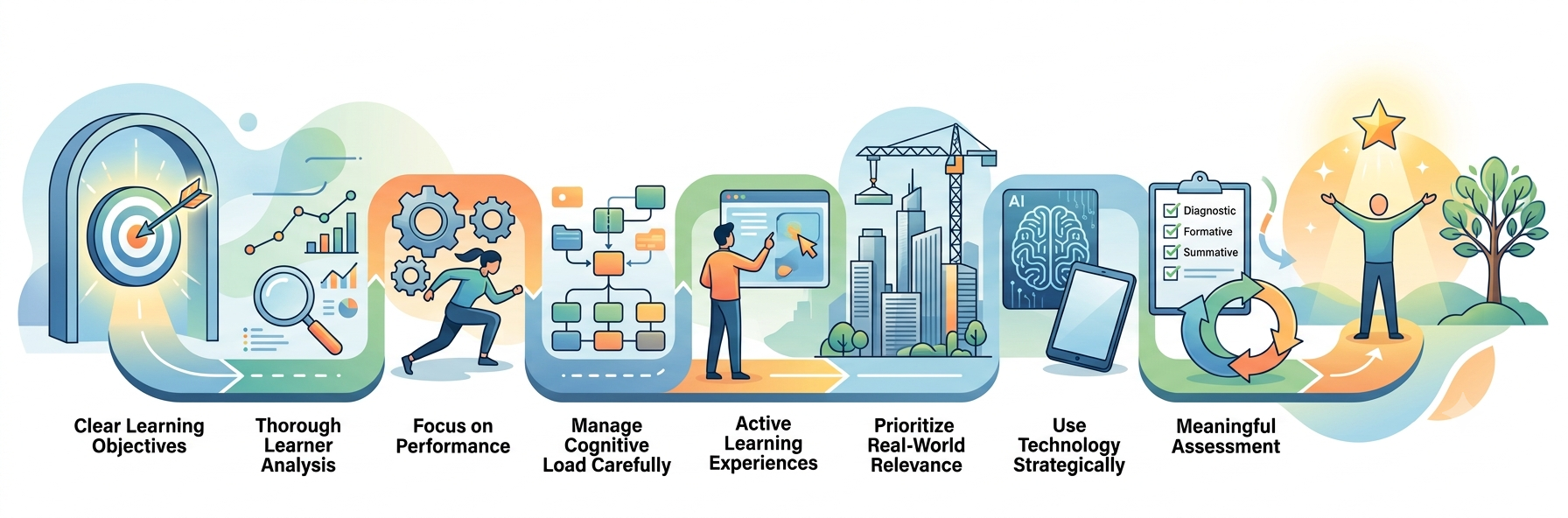
Start with Clear Learning Objectives
Every successful learning initiative begins with a clear understanding of the desired outcome.
Without defined objectives, training programs often become collections of information rather than purposeful learning experiences. Objectives provide direction for content development, assessments, and learner activities.
Effective learning objectives should be:
-
Specific and measurable
-
Relevant to learner needs
-
Aligned with organizational goals
-
Achievable within the learning environment
-
Focused on observable outcomes
For example, instead of stating that learners should “understand project management principles,” a stronger objective would be “create a project timeline that includes milestones, dependencies, and resource allocation.”
Clear objectives help instructional designers make informed decisions throughout the development process while ensuring learners understand what success looks like.
Conduct a Thorough Learner Analysis
Before creating content, selecting activities, or choosing delivery formats, instructional designers need to understand exactly who they are designing for. Modern training programs increasingly rely on data, analytics, and specialized learning design software to better understand learner behavior, identify knowledge gaps, and create more targeted educational experiences.
No learning solution works equally well for every audience. A course that performs well for entry-level employees may fall short for experienced professionals, while highly technical materials can overwhelm beginners.
Effective learner analysis examines several important factors.
Existing Knowledge Levels
Learners arrive with different backgrounds, experiences, and expectations. Understanding their current level of expertise helps determine how much foundational information is necessary and where deeper instruction should begin.
Motivation and Expectations
People engage with learning for different reasons. Some participate voluntarily to advance their careers, while others complete training because it is required. Knowing what motivates learners can significantly influence engagement strategies and content design.
Learning Environment
The context in which learning occurs matters. Remote employees, field workers, hybrid teams, and classroom learners often face different challenges and opportunities. Training should fit naturally into their daily routines whenever possible.
Technical Capabilities
Technology should make learning easier, not more complicated. Designers should consider factors such as device preferences, internet accessibility, platform familiarity, and overall digital literacy.
A thorough learner analysis often uncovers insights that influence everything from content complexity to assessment methods. By understanding learners before development begins, organizations can create training experiences that feel more relevant, more engaging, and ultimately more effective.
Focus on Performance Rather Than Information
One of the most common mistakes in learning design is treating training as an information delivery exercise.
In reality, learners rarely need information for its own sake. They need knowledge that helps them perform tasks, solve problems, and make better decisions.
Instead of asking what content should be included, instructional designers should focus on what learners must be able to accomplish after training.
Questions worth asking include:
-
What tasks must learners perform?
-
What mistakes occur most frequently?
-
Which skills have the greatest impact on performance?
-
What obstacles prevent success?
This performance-oriented mindset helps eliminate unnecessary content while increasing practical relevance.
Manage Cognitive Load Carefully
Human attention and memory are limited resources.
When learners receive too much information at once, retention suffers. Effective instructional design accounts for these limitations by presenting information in manageable chunks.
Several strategies help reduce cognitive overload:
-
Breaking complex topics into smaller lessons
-
Using clear visual organization
-
Eliminating unnecessary distractions
-
Introducing concepts progressively
-
Supporting ideas with examples and practice
The growing popularity of microlearning reflects these principles. Short, focused learning experiences often produce better engagement and retention than lengthy information-heavy sessions.
The goal is not to simplify important concepts excessively but to structure learning in ways that support understanding.
Create Active Learning Experiences
People learn more effectively when they actively engage with material rather than passively consume information.
Active learning encourages learners to think critically, make decisions, apply concepts, and reflect on outcomes.
Examples include:
-
Scenario-based learning
-
Interactive simulations
-
Knowledge checks
-
Case studies
-
Guided discussions
-
Problem-solving activities
These approaches encourage deeper cognitive processing and often improve long-term retention.
For workplace learning, realistic scenarios are especially valuable because they connect training directly to everyday responsibilities.
Prioritize Real-World Relevance
Adults are far more likely to engage with learning when they understand its practical value.
Content that feels disconnected from real-world challenges often struggles to maintain attention. Effective instructional design consistently demonstrates how concepts apply to actual situations.
Practical relevance can be strengthened through:
-
Workplace examples
-
Industry-specific case studies
-
Authentic scenarios
-
Realistic simulations
-
Performance-focused activities
When learners immediately recognize how information can help them succeed, motivation naturally increases.
Use Technology Strategically
Technology continues to transform the learning landscape, but effective instructional design should never be driven solely by tools.
New platforms, AI-powered systems, immersive technologies, and advanced analytics can enhance learning experiences. However, technology is most effective when it supports educational goals rather than distracts from them.
Before adopting new solutions, instructional designers should consider:
-
Does this improve learning outcomes?
-
Does it increase accessibility?
-
Does it simplify the learning experience?
-
Does it support meaningful engagement?
Technology should remove barriers and strengthen learning rather than add unnecessary complexity.
Build Meaningful Assessment Strategies
Assessment is most valuable when it serves learning rather than simply measuring completion.
Strong instructional design integrates assessment throughout the learning process.
Diagnostic Assessments
These identify learners’ existing knowledge before instruction begins.
Formative Assessments
These provide ongoing feedback and help learners track progress during training.
Summative Assessments
These evaluate achievement after instruction is complete.
Performance-Based Assessments
These require learners to demonstrate practical application of skills and knowledge.
Performance-based assessments are particularly effective because they measure what learners can actually do rather than what they can temporarily remember.
Incorporate Continuous Feedback
Feedback plays a critical role in learning and improvement.
Without feedback, learners often struggle to identify misconceptions or refine their skills. Effective feedback provides clear guidance while encouraging continued progress.
The most useful feedback is:
-
Timely
-
Specific
-
Actionable
-
Constructive
-
Focused on improvement
Whether delivered through instructors, peers, managers, or automated systems, feedback should support meaningful growth rather than simply evaluate performance.
Design for Accessibility and Inclusion
Accessibility is no longer viewed as an optional enhancement. It is an essential component of modern instructional design.
Inclusive learning experiences accommodate diverse learners while improving usability for everyone.
Important considerations include:
-
Readable content structures
-
Alternative text for visuals
-
Captions for multimedia
-
Keyboard accessibility
-
Clear language
-
Flexible learning pathways
Inclusive design also involves recognizing different cultural perspectives, experiences, and learning preferences.
When accessibility is incorporated from the start, learning becomes more equitable and effective.
Measure Success Beyond Completion Rates
Many organizations still rely heavily on completion statistics when evaluating training programs.
While completion data can provide useful insights, it rarely tells the full story.
More meaningful indicators include:
-
Knowledge retention
-
Skill application
-
Behavioral change
-
Productivity improvements
-
Error reduction
-
Business impact
Effective instructional design focuses on outcomes that extend beyond course completion and contribute to organizational success.
The most valuable learning programs create measurable improvements in performance.
Conclusion
The fundamentals of instructional design remain remarkably relevant in 2026 despite rapid technological advancement. New platforms, artificial intelligence, adaptive learning systems, and sophisticated analytics continue to expand what is possible, but successful learning experiences still depend on the same foundational principles.
Clear objectives, learner-centered planning, active engagement, practical relevance, meaningful assessment, and continuous improvement remain the building blocks of effective learning design. Organizations that embrace these principles are better positioned to develop skilled employees, support ongoing professional growth, and adapt to changing business demands.
Perhaps the most important lesson is that instructional design is ultimately about people, not content. Information alone rarely changes behavior or improves performance. Effective learning experiences help individuals connect knowledge with action, allowing them to solve problems, build confidence, and achieve meaningful goals.
As workplace learning continues to evolve, these best practices provide a reliable framework for creating educational experiences that deliver lasting value. Whether developing corporate training programs, academic courses, onboarding initiatives, or professional development pathways, instructional designers who prioritize learner needs and measurable outcomes will continue to achieve the strongest results.
Published: July 1, 2026