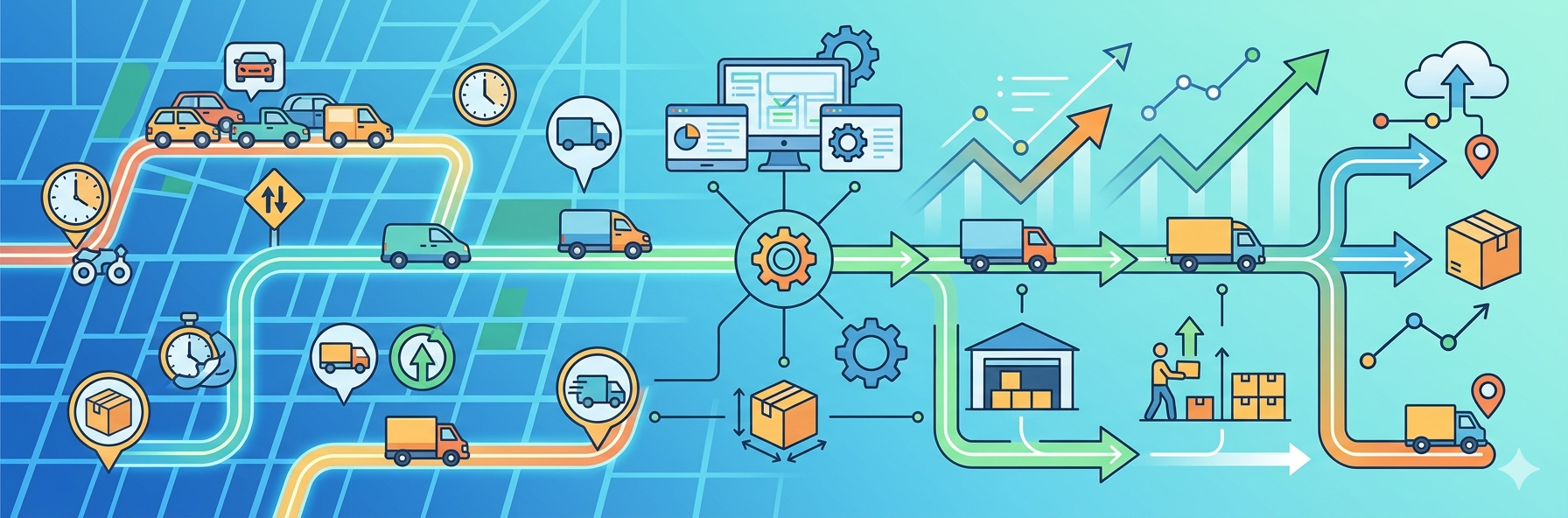
Delivery workflow planning fails when teams plan from averages. Real routes have traffic, loading delays, customer time windows, parking limits, failed attempts, driver breaks, and vehicle capacity issues.
A strong workflow starts with constraint mapping. Teams should define what can slow the route before orders are assigned. This includes service time per stop, package size, address type, delivery priority, depot cut-off time, and proof-of-delivery rules.
Last-mile work deserves close control. Capital One Shopping reports that last-mile delivery made up 53% of total shipping costs in 2024. That makes poor planning expensive, not just inconvenient.
Centralize Order and Route Data
Teams need one shared source of truth. Spreadsheets, chat threads, and manual dispatch notes create version conflicts. They also hide late changes from drivers and support teams.
A delivery workflow should connect orders, inventory status, route plans, customer notes, driver availability, and delivery confirmation. This is where teams often evaluate software for last mile delivery as part of a broader planning stack. The value is not the tool alone. The value comes from cleaner data, faster route decisions, and fewer handoffs.
Good planning data should include:
- Accurate geocoded addresses
- Delivery time windows
- Vehicle load capacity
- Driver shift limits
- Package dimensions and weight
- Priority rules for urgent orders
- Failed delivery history
When this data is structured, route planning becomes operational. It stops being guesswork.
Segment Deliveries Before Routing
Not every delivery should enter the same workflow. Teams should segment orders before route optimization. This prevents high-value, urgent, bulky, or fragile orders from being treated like standard parcels.
Useful segments include same-day orders, scheduled deliveries, business addresses, residential addresses, returns, cold-chain items, and oversized packages. Each segment needs different handling rules.
For example, business deliveries should often be routed earlier in the day. Residential deliveries may perform better later. Bulky items may need fewer stops per vehicle. Returns may be grouped into backhaul routes to reduce empty miles.
Plan Capacity Before Demand Peaks
Many teams plan routes after demand arrives. That creates pressure. Better teams plan capacity scenarios first.
Capacity planning should include driver count, vehicle volume, shift hours, depot throughput, picking speed, packing time, and dispatch cut-off rules. If one part is weak, the whole workflow slows.
A simple capacity check can prevent missed promises. Teams should compare planned order volume with available delivery hours. They should also model peak days. Promotions, holidays, weather events, and local disruptions can change the route profile fast.
Use Route Rules, Not Manual Fixes
Manual route editing is useful in exceptions. It should not be the main process. Teams need routing rules that match business goals.
Common rules include shortest distance, lowest fuel use, fastest delivery time, time-window priority, zone density, driver familiarity, and vehicle type. The best rule depends on the service promise.
A grocery team may prioritize freshness and time windows. A furniture team may prioritize truck capacity and unload time. A courier team may prioritize route density and fast reassignment.
Workflow planning improves when rules are written down. Dispatchers then solve exceptions instead of rebuilding routes from scratch.
Improve Handoffs Between Teams
Delivery planning touches several teams. Operations, warehouse staff, dispatchers, drivers, support agents, and customer success all affect the final result.
Weak handoffs create hidden delays. A packed order that misses staging can delay a route. A driver who receives the wrong customer note may fail the stop. A support agent without live status may give poor updates.
Teams should define handoff points clearly:
- Order released to warehouse
- Picking completed
- Packing completed
- Route assigned
- Vehicle loaded
- Driver departed
- Delivery attempted
- Proof captured
- Exception resolved
Each point should have an owner, timestamp, and status rule.
Track Exceptions as Planning Inputs
Failed deliveries, late arrivals, wrong addresses, damaged packages, and missed cut-offs should not be treated as isolated events. They are planning data.
Teams should review exceptions weekly. The goal is to find repeat patterns. A zone may have frequent parking issues. A customer type may need better notifications. A depot may need an earlier packing deadline.
Exception data helps teams adjust routes, staffing, customer communication, and packaging rules. Over time, it reduces firefighting.
Measure Workflow Performance
Planning quality should be measured with operational metrics. On-time delivery rate is important, but it is not enough.
Teams should also track route completion rate, cost per stop, distance per delivery, failed first attempts, average service time, driver idle time, loading accuracy, and customer contact rate.
These numbers show where the workflow is breaking. They also show whether process changes work.
Conclusion
Better delivery workflow planning comes from structure. Teams need clean data, clear constraints, route rules, capacity planning, and exception reviews.
The best delivery teams do not rely on heroic dispatching. They design workflows that make good decisions repeatable. That reduces cost, protects service levels, and gives customers a more predictable delivery experience.
Published: May 27, 2026