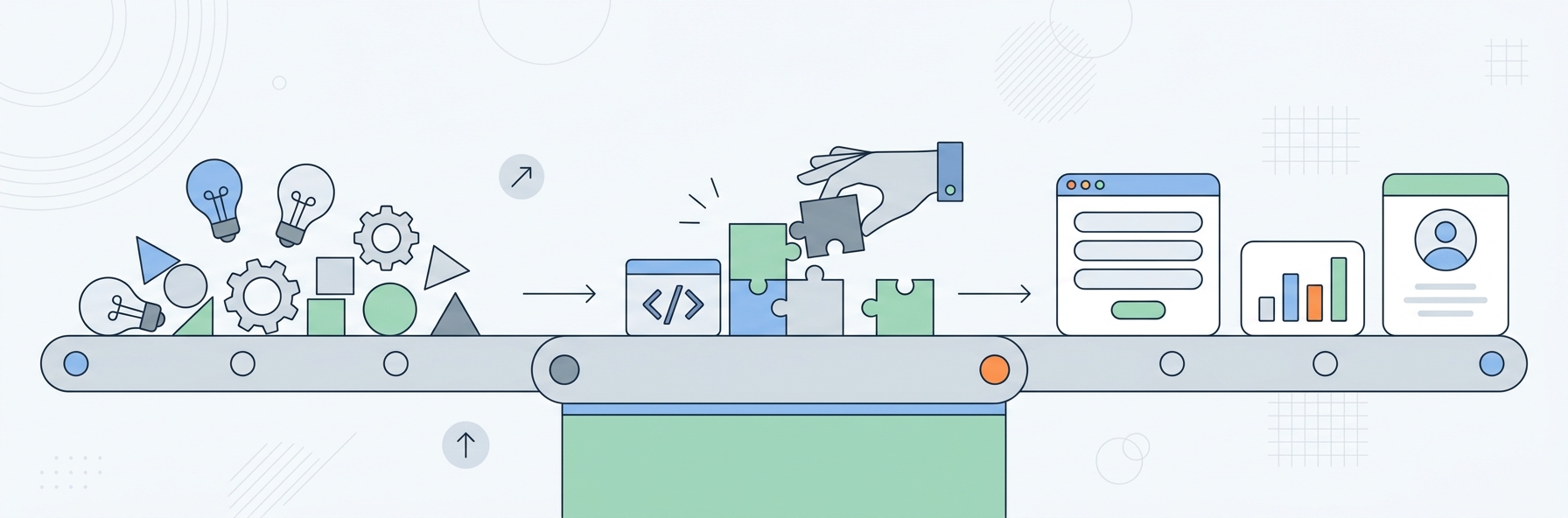
A good idea inside a company rarely dies from lack of enthusiasm. It dies in a queue. Someone in operations sketches a tracker on a whiteboard, the request lands with engineering, and the roadmap already has eleven things ahead of it. Six weeks later, the spreadsheet everybody hated is still the system of record.
Low-code development exists because that queue is expensive. Visual builders let people assemble a working application out of configured components instead of hand-written plumbing, and Oracle’s own documentation for APEX puts it plainly: you define pages by configuring built-in components, and you add code only for the custom business logic that nobody else could write. Coding does not disappear. It stops being the toll booth on every small request.
What follows is less about platform shopping and more about the shape of the work: who contributes, what gets built first, where visual tools quietly save weeks, and what goes wrong when nobody is watching.
The Gap Between an Idea and a Working Tool
The distance between we should track this and we have a tool that tracks this is mostly translation loss. The person with the problem writes a document. A developer reads that document, interprets it, builds something, and demos it three weeks later. Half the demo is wrong, not because anyone was careless, but because requirements written in prose are a lossy format.
Visual development collapses that loop. When the person who understands a process can drag a form onto a page, wire it to a table, and look at the result the same afternoon, the conversation stops being about specs and starts being about the actual screen. Research on low and no-code adoption describes these platforms as giving non-IT professionals a practical way to build the simple business applications they need with little or no coding, and the word simple is doing honest work there. Most internal tools are simple. They are just numerous.
What Visual Development Environments Actually Change
Three things shift in practice. The feedback cycle shrinks from weeks to hours. Ownership moves, so the team that lives with a process ends up holding the thing that runs it and small fixes no longer need a ticket. And the floor on quality rises, because authentication, audit trails, responsive layout, and database access arrive from the platform rather than from whoever had time to wire them up.
That last point gets underrated. A hand-rolled internal app inherits whatever security its author happened to remember on a Tuesday, while a platform app inherits the platform’s defaults, and those defaults usually beat an improvised login screen. The full argument for low-code benefits runs longer than this, but the short version is that your leverage comes from the parts you no longer have to build.
How Mixed Teams Divide the Work
The most productive setups are not the ones where business users replace engineers. They are mixed. An operations lead models the process and builds the screens, a developer writes the two procedures that do something genuinely tricky, and somebody who knows the data checks the schema before it hardens. Oracle reports one internal instance carrying more than 7,000 active workspaces and thousands of production applications, which is less a vendor flex than a hint about scale: once building gets cheap, demand turns up everywhere.
That division works when roles are explicit. Prototype first, with real data and fake polish, then decide what graduates. A tool three people open once a quarter can stay rough forever, while anything touching payroll, customers, or compliance earns a code review and a named owner. Teams that skip the triage wake up with two hundred apps and no idea which ones matter.
The Processes Worth Automating First
Start where the pain is boring and repeated. Intake forms that currently arrive as email. Approvals that live in a thread nobody can find. The status summary one person assembles by hand every Monday before a meeting. None of these are glamorous builds, and that is exactly why they pay off: the work is well understood, the rules are stable, and nobody argues about requirements because everyone has already suffered them.
Workflow automation is the natural second layer, once information stops arriving as attachments. Weje’s own breakdown of AI automation in business workflows argues that disconnected systems and manual handoffs create most of the delay in a process, which matches what a low-code rollout tends to expose. Building the app is rarely the hard part. Getting one shared record instead of four drifting copies is.
The Guardrails That Keep Low-Code Honest
Speed invites sloppiness, and the sloppiness follows a pattern. Apps with no owner. Credentials pasted into a configuration field because it was faster. Three versions of the same form, built by three people who never searched first. A light registry plus a quarterly review handles nearly all of it, and neither one requires a governance committee or a new job title.
AI assistance adds a wrinkle worth naming. Generated logic reads confidently whether or not it is correct, and developers themselves are not sold: in Stack Overflow’s 2025 developer survey, 46 percent said they actively distrust the accuracy of AI output against 33 percent who trust it, and the most experienced respondents were the most skeptical of all. So treat generated code and generated app scaffolding the way you would treat a contractor’s first draft. Fast, useful, and in need of a careful read.
None of this makes engineering optional. Hard systems stay hard, and the problems that deserve real architecture will still eat real months of senior time. What changes is the mix. The long tail of small, obvious, internal applications stops competing for the same scarce attention, and the people closest to the work get to build their own fix instead of describing it to somebody else.
The practical move is small and immediate. Pick one process everybody complains about, build a rough version this week alongside the people who actually run it, and put it in front of five users. You will learn more from their first ten minutes than from a quarter of planning, and you will find out quickly whether a visual builder fits the way your team thinks.
Ideas were never the scarce resource. The path from an idea to working software is, and low-code is how you shorten it.
Published: November 7, 2026