Employer of Record (EOR) & Global Hiring Platforms
When a company wants to hire talent in a new country without setting up a local legal entity, an Employer of Record platform, such as Borderless AI, or other similar ones, fills that gap. These platforms act as the legal employer on your behalf, managing local contracts, tax withholding, and labor law compliance across dozens — sometimes hundreds — of countries.
What to look for: Coverage across the countries you operate in, in-country legal expertise, AI-driven onboarding automation, and unified dashboards for managing both full-time employees and contractors.
Example use case: A tech startup in the U.S. hires engineers in Germany, Brazil, and the Philippines. Instead of opening three foreign subsidiaries, they use an EOR platform to onboard all three within days, fully compliant with local laws.
Project Management & Task Tracking Tools
Distributed teams need a single source of truth for who is doing what and by when. Project management tools give managers the ability to assign tasks, set deadlines, track dependencies, and monitor progress — all without relying on scattered email threads.
What to look for: Multiple view options (board, list, timeline, calendar), support for task dependencies and milestones, built-in templates for common workflows, and integrations with communication tools.
Example use case: A marketing team spread across five countries uses a shared project board to manage a product launch. Every member sees their tasks, deadlines, and blockers in real time, regardless of their time zone.
Real-Time Team Communication Platforms
Email alone cannot support the speed that global teams require. Dedicated communication platforms organize conversations into channels by topic, team, or region, making it easier to find information and reduce inbox overload.
What to look for: Organized channel structures, powerful search for past messages and files, mobile and desktop access, and deep integrations with project management and file-sharing tools.
Example use case: A customer support team with agents in Asia, Europe, and North America uses dedicated channels for each region and shared channels for escalations. Agents resolve issues faster because context is always one search away.
Global Payroll & Compliance Software
Paying employees across multiple countries is one of the most operationally complex parts of running a global team. Payroll platforms designed for international use automate calculations, handle multi-currency payments, stay updated on local tax regulations, and generate compliant documentation automatically.
What to look for: Multi-country and multi-currency support, automated tax filing, contractor and employee management in one system, built-in compliance alerts when local laws change, and access to in-house legal or HR specialists.
Example use case: A 200-person company with staff in 18 countries processes payroll for all of them on a single platform. When a new payroll tax is introduced in one country, the system flags the change and adjusts calculations automatically before the next pay run.
Time Zone & Availability Management Tools
One of the most overlooked challenges in managing global teams is simply knowing when people are available. Scheduling a meeting across multiple continents without a visual reference often leads to conflicts, missed calls, and late-night invites that hurt morale.
What to look for: A clear visual layout showing each team member’s local time, overlap hour identification, simple onboarding with no steep learning curve, and integration with calendar tools.
Example use case: A product manager in London uses a team availability dashboard before scheduling sprint planning. She instantly sees that her developers in Tokyo and São Paulo share a two-hour overlap window and books the call accordingly — no spreadsheet required.
Beyond payroll, international teams need systems to manage performance reviews, onboarding documents, leave policies, and benefits that vary by country. A centralized HR platform keeps employee records accurate and ensures nothing falls through the cracks.
What to look for: Document storage and e-signature support, localized leave and benefits management, performance review workflows, and role-based access controls for sensitive data.
Example use case: An HR manager uses a single platform to onboard a new hire in Canada, complete with a locally compliant contract, tax forms, and a benefits enrollment flow — all without printing a single piece of paper.
Conclusion
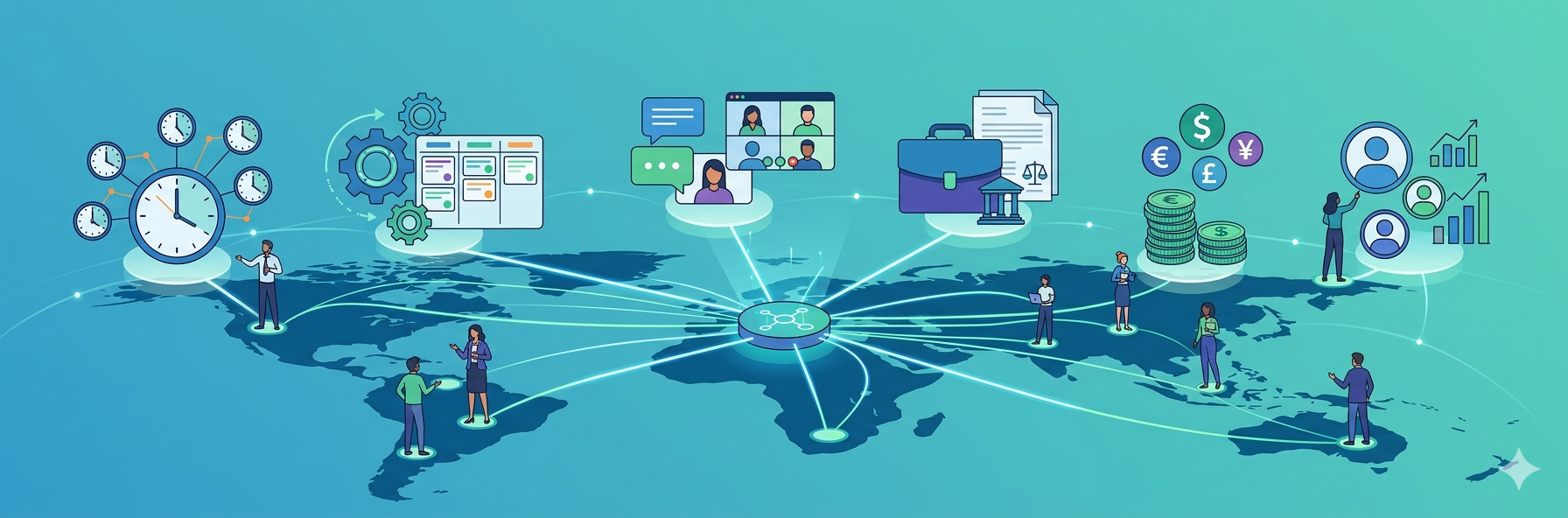
There is no single tool that handles everything, but a thoughtfully assembled stack can eliminate most of the friction that slows global teams down. The right combination of an EOR platform, project management software, team communication tools, global payroll software, time zone visibility tools, and a centralized HR system gives leaders the control and visibility they need to scale confidently across borders. Companies that invest in these systems early spend less time managing confusion and more time building great products with great people — wherever in the world they happen to be.
Published: April 8, 2026